
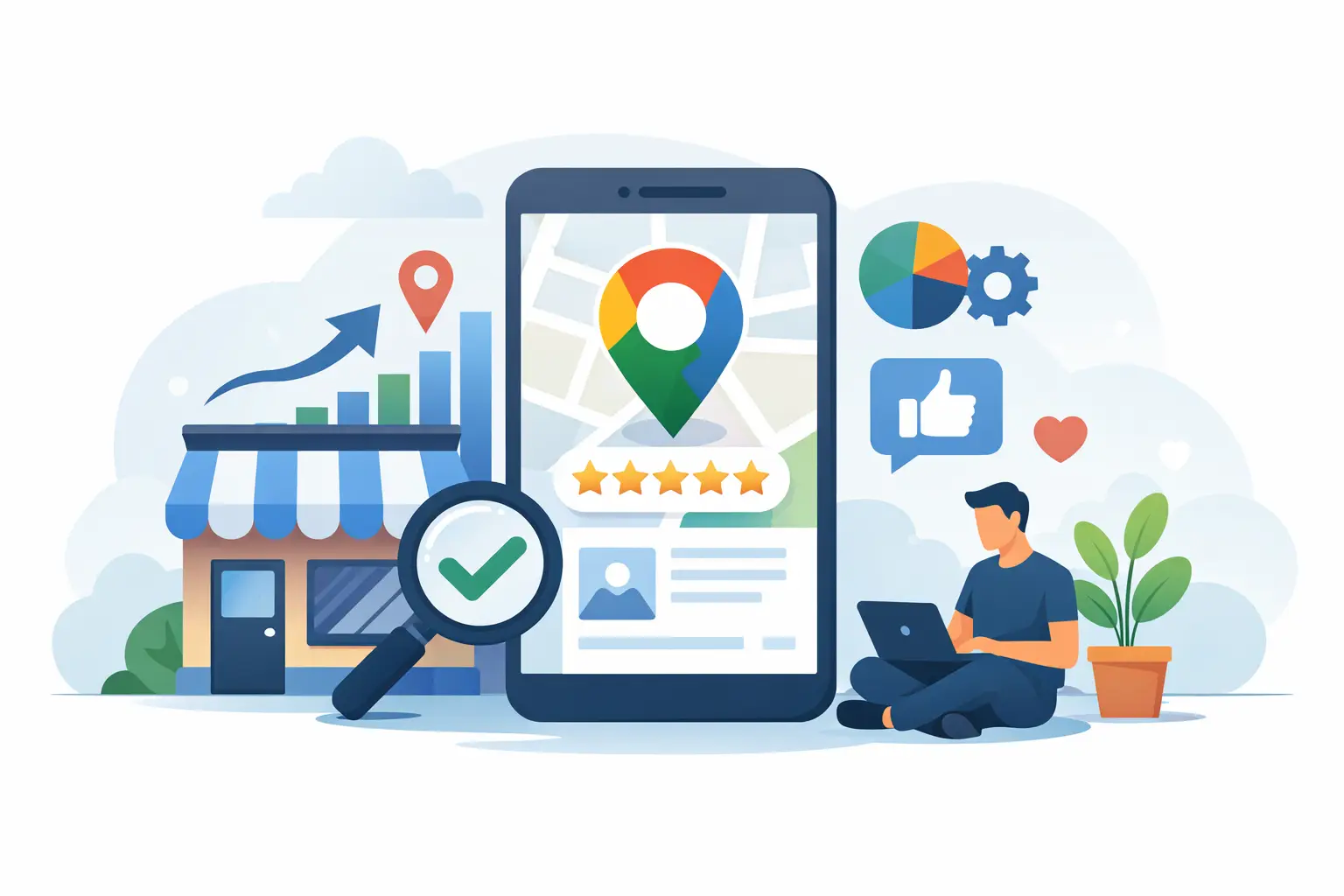
A local search loss usually does not happen because your website disappeared. It happens because a competitor has a tighter Google Business Profile, better category targeting, fresher photos, and stronger review signals.
That is why google business profile optimization matters. For many local searches, your profile is the first impression, the click driver, and the lead source before a user ever visits your website. If it is incomplete, inconsistent, or weakly positioned, you lose visibility where buying intent is highest.
Google Business Profile Optimization
Google Business Profile optimization is the process of improving your listing so it ranks better in local results, earns more profile actions, and sends stronger trust signals to Google and customers. That includes your business categories, services, description, reviews, images, FAQs, updates, and the consistency between your profile and website.
This is not a one-time setup task. It is an ongoing local SEO asset that should reflect search intent, business accuracy, and real customer proof.
Why optimization affects rankings and leads
Google uses a mix of relevance, distance, and prominence in local results. You cannot control a searcher’s location, but you can influence how relevant and credible your business appears.
A well-optimized profile helps Google understand what you offer, where you operate, and why your business deserves visibility. It also improves conversion after the impression. A profile that clearly states services, shows recent photos, and has strong reviews gives users fewer reasons to keep comparing options.
For service businesses, this often means more calls and quote requests. For local retailers and clinics, it can mean more direction requests, website visits, and store visits. The ranking gain matters, but the conversion lift is usually where the real value shows up.
The core elements of google business profile optimization
The basics still matter because they shape entity clarity. If Google sees conflicting or thin business data, local performance tends to stall.
Primary and secondary categories
Your primary category carries serious ranking weight. It should describe the core service that drives your business, not the broadest label available. Secondary categories add context, but they should support your main offer rather than dilute it.
If you are a cosmetic dentist, for example, choosing “Dentist” may be necessary, but there are cases where a more specific category aligns better with actual search demand. The right choice depends on your market, competition, and service mix.
Services and products
Your services section should be complete and specific. Avoid vague labels like “consulting” or “repairs” when users actually search for “air conditioner repair,” “kitchen renovation,” or “corporate tax filing.”
This is where search intent mapping matters. The language in your profile should mirror the way customers search, while staying accurate to the business.
Business description
The description does not carry the same weight as categories, but it helps reinforce relevance and clarity. Keep it factual, readable, and aligned with your highest-value services and location context.
Do not treat this like ad copy. Treat it like a structured explanation of who you help, what you do, and where you operate.
NAP consistency
Your business name, address, and phone number need to match across your profile, website, and major citations. Even small inconsistencies can weaken trust signals.
If you use suite numbers, alternate phone lines, or slightly different brand formatting, standardize them. Consistency supports both local SEO and entity recognition.
Reviews are not just trust signals
Reviews influence both conversion and local visibility. Quantity matters, but quality and relevance matter too.
A profile with frequent, detailed reviews that mention specific services sends a stronger signal than one with a high star rating but thin review text. Reviews also shape user behavior. If two businesses appear similar in rank, the one with better review proof often wins the click.
You should ask for reviews continuously, not in bursts. A natural review velocity looks healthier than a sudden spike followed by silence. Responding to reviews also helps. It shows activity, builds trust, and gives you another chance to reinforce service relevance in natural language.
What you should not do is over-script customer responses or chase only five-star reviews. Google’s systems and users both respond better to authenticity.
Photos, updates, and engagement signals
Many businesses ignore media until they redesign their brand. That is a mistake. Fresh visual content makes the profile feel active and credible.
Upload real photos of your location, team, products, projects, and customer experience. Stock-style images rarely help. Users want proof that the business is real, current, and professional.
Google Posts and profile updates can also support engagement, especially for promotions, events, seasonal services, and new offerings. They are unlikely to fix weak rankings on their own, but they improve profile freshness and give users more reasons to act.
There is a trade-off here. Posting every day is rarely necessary for a small business. Posting consistently when there is something useful to say is more practical and more sustainable.
Your website still shapes local performance
A Google Business Profile does not operate in isolation. Your website helps validate business relevance, service depth, and local authority.
If your profile says you offer emergency plumbing in Dallas, but your website barely mentions plumbing and has no clear service-area structure, that mismatch limits performance. Google wants corroboration.
This is where technical SEO and local landing pages become important. A strong site gives your profile supporting evidence through:
- clear service pages
- localized intent targeting
- crawlable business information
- structured content and schema
- fast mobile performance
For businesses that want stronger AI visibility as well as traditional rankings, the connection matters even more. Entity-based SEO works best when your profile, website, and branded signals all tell the same story.
Common problems that hold profiles back
Some profiles are underperforming because they are incomplete. Others are being quietly limited by strategy mistakes.
The most common issues include choosing the wrong primary category, stuffing keywords into the business name, ignoring duplicate listings, using weak service descriptions, and linking to a homepage when a relevant location or service page would perform better.
Spam is another factor. In some industries, competitors manipulate names or categories to gain short-term local visibility. You should know that this happens, but copying bad tactics is risky. Suspensions and trust issues are harder to fix than slow growth.
A better path is to build a profile that is accurate, complete, and strongly supported by your site and review strategy.
How to approach optimization the right way
Start with an audit. Check categories, services, business info, review quality, photos, Q&A, updates, and landing page alignment. Then compare your profile against the businesses that consistently rank in the local pack for your core terms.
This comparison matters because local SEO is relative. A profile may be technically complete and still be weak for the market if competitors have stronger review signals, better category alignment, and more relevant website support.
After the audit, prioritize fixes based on impact. Category selection, landing page alignment, and review acquisition usually deserve attention before low-impact cosmetic changes.
Then monitor performance over time. Track calls, direction requests, website clicks, keyword visibility, and profile interactions. Rankings alone do not tell the full story. If visibility improves but leads do not, the issue may be conversion messaging rather than local position.
When to DIY and when to get help
If you run a single-location business in a low-competition market, you can handle a lot of this internally. Basic setup, review requests, service updates, and photo uploads are manageable with the right checklist.
If you operate in a competitive city, have multiple locations, or need local SEO to support meaningful revenue growth, the margin for error gets smaller. That is where structured implementation helps. You need accurate entity signals, keyword-to-service mapping, technical website support, and a reporting framework that connects visibility to leads.
That is also why many businesses treat google business profile optimization as part of a larger local search strategy rather than a standalone task. The profile gets the click, but the website, reviews, and broader search presence drive sustained growth.
At Creative Site, we approach local visibility the same way we approach modern SEO – built for Google, structured for AI visibility, and grounded in measurable search intent.
FAQ
How long does Google Business Profile optimization take to show results?
Some updates, such as category changes or improved profile completeness, can influence performance within days or weeks. Review growth, authority, and sustained local ranking improvements usually take longer. Competitive markets require more patience.
Does posting on Google Business Profile improve rankings?
Posts can support freshness and engagement, but they are not usually the main ranking driver. Categories, reviews, business relevance, website alignment, and proximity tend to matter more.
Should I add keywords to my business name?
Only use your real-world business name. Adding extra keywords may create short-term gains in some markets, but it violates Google guidelines and can lead to suspensions or edits.
What is the most important part of local profile optimization?
There is no single element. The highest impact usually comes from the combination of correct categories, complete services, strong reviews, accurate business data, and a website that reinforces local intent.
Local search is rarely won by one big trick. It is won by tightening the details that prove your business is the best answer for the search.

Leave a Reply