
Keyword SEO: Understand What People Search For.
Keywords connect what people type into Google with the content businesses create. Learn how keywords work, how search intent changes their value and how to choose the right keywords for SEO.
What is an SEO keyword?
A keyword is a word or phrase people use when searching for information, products, services or answers through a search engine.
For example, someone looking for an air conditioning service may search for "aircond service Shah Alam". Someone who is still trying to solve the problem themselves may search for "why is my aircond not cold".
Both are keywords, but the person behind each search has a different goal. One wants to learn about a problem, while the other may already be looking for a service provider. Understanding this difference is called search intent.
From a search to your website.
Keywords help search engines connect a user's query with pages that may satisfy their search intent.
User Has a Need
A person wants information, a product, a service or a solution to a problem.
User Searches
They express that need using words or phrases through Google or another search platform.
Google Interprets Intent
Search systems try to understand what the user actually wants to achieve.
Relevant Pages Appear
Search results are selected based on relevance, quality, authority and many other signals.
Four major types of keyword intent.
Hover over each card to see examples. The closer a search is to a purchase decision, the stronger its commercial intent usually becomes.
Informational
The user wants to learn or find an answer.
“why is my aircond not cold”
“how to clean aircond filter”
“how often should aircond be serviced”
Best ContentGuides, tutorials, FAQs and educational content.
Navigational
The user already knows where they want to go.
“Shopee Malaysia”
“Maybank2u login”
“AirAsia booking”
Best ContentHomepages, branded pages, login pages and specific website destinations.
Commercial
The user is researching before making a decision.
“best homestay in Melaka”
“best aircond brand Malaysia”
“best running shoes for beginners”
Best ContentComparisons, reviews, list articles and buying guides.
Transactional
The user is ready to take an action.
“book homestay Melaka”
“aircond service Shah Alam”
“buy birthday cake online”
Best ContentService pages, product pages, booking pages and conversion-focused landing pages.
Search intent across the buyer journey
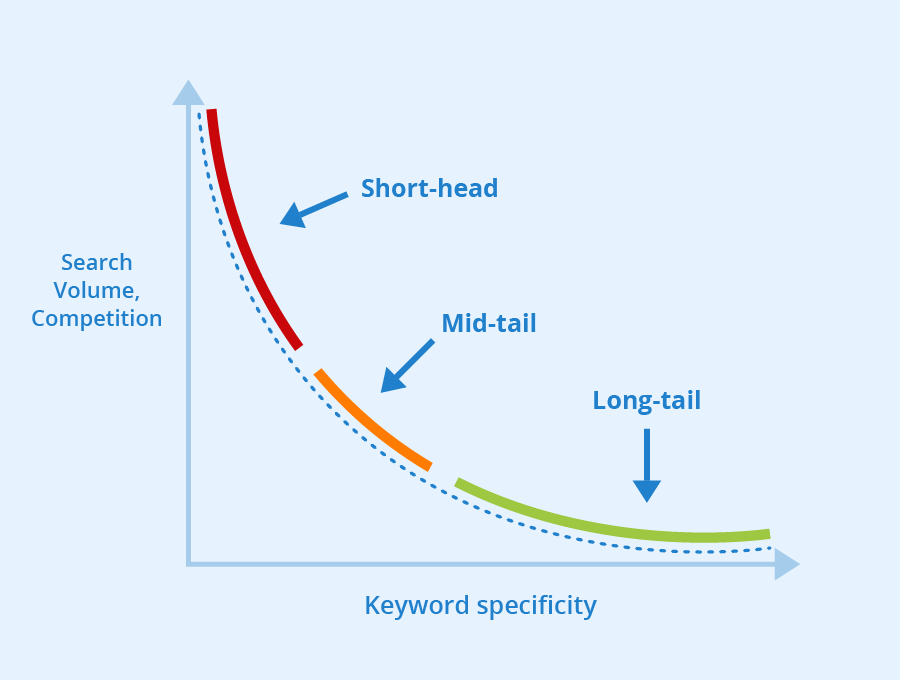
Short-tail, mid-tail and long-tail keywords.
Keywords can also be grouped by how broad or specific they are. As a phrase becomes more specific, we usually learn more about what the searcher actually wants.
Keywords can be classified in different ways.
Length and buyer intent are only two ways of understanding keywords.
Branded Keywords
Searches that contain the name of a specific company, product or brand.
Non-Branded Keywords
Generic searches where the user has not specified which company or brand they want.
Local Keywords
Searches where the user is looking for a business, product or service within a specific location.
Primary Keyword
The main search topic a specific page is designed to target.
Secondary Keywords
Closely related phrases that support the main topic of a page.
Question Keywords
Search queries expressed as questions because the user wants a specific answer.
Don't choose keywords from search volume alone.
Keyword tools provide useful metrics, but business relevance and search intent should always be part of the decision.
An estimate of how frequently people search for a keyword during a given period.
An estimate of how competitive a keyword may be to rank for organically.
The underlying reason behind the search: learn, navigate, compare or take action.
How closely the keyword relates to your products, services and ideal customers.
Estimated advertising cost per click. It can indicate commercial value, but it is not an SEO ranking factor.
The actual websites, page types and search features already ranking for the query.
A simple keyword research process.
Good keyword research starts with understanding the business and its customers, not simply opening a keyword tool.
Understand the Business
List the products, services, customer problems, locations and main business goals.
Create Seed Keywords
Start with broad phrases that describe the business. For example, a bakery may begin with “birthday cake”, “custom cake” and “cake delivery”.
Expand Keyword Ideas
Use Google suggestions, Google Search Console, competitor research and keyword tools to discover related searches.
Identify Search Intent
Determine what the searcher actually expects to see when they use each keyword.
Review Competition
Search the keyword and study the pages already ranking. Look at their page type, purpose and content format.
Prioritise Opportunities
Balance relevance, intent, competition and potential business value instead of chasing search volume alone.
Map Keywords to Pages
Assign related keyword groups to the appropriate page to create a clear website structure and avoid unnecessary overlap.
Example: Keyword Research for a Bakery
Match the keyword with the right page.
Keyword mapping helps decide which page should target each keyword cluster and search intent.
| Keyword | Intent | Recommended Page | Role |
|---|---|---|---|
| aircond service Shah Alam | Transactional / Local | Aircond Service Shah Alam | Service / location page |
| why is my aircond not cold | Informational | Blog Article | Educational content |
| best running shoes for beginners | Commercial | Buying Guide | Consideration content |
| book homestay Melaka | Transactional | Booking Page | Conversion page |
| how much does teeth whitening cost | Informational / Commercial | Teeth Whitening Guide | Supporting content |
What is keyword cannibalisation?
Keyword cannibalisation can happen when multiple pages target the same or very similar search intent, making it less clear which page should rank.
✕ Weak Structure
Page 1: Birthday Cake Delivery KL
Page 2: Best Birthday Cake Delivery KL
Page 3: Order Birthday Cake KL
If all three pages serve essentially the same commercial intent, they may compete with each other unnecessarily.
✓ Better Structure
One strong Birthday Cake Delivery page targets the main commercial keyword cluster.
Supporting articles can answer different informational searches such as cake sizes, flavours, designs and ordering tips.
Each page has a clear purpose and search intent.
Remember these five things.
Keyword SEO Quiz
Answer all five questions and check your score.