Search has changed more in the last two years than it did in the previous decade. If you are a business owner in Malaysia trying to grow your online visibility, you have probably heard of SEO. But two newer terms are becoming just as important — AEO and GEO.
Understanding what SEO, AEO, and GEO mean and how they work together is now essential for any business that wants to be found online. Whether someone searches on Google, asks ChatGPT a question, or uses Google’s AI Mode, your business needs to show up in the right place at the right time.
In this guide, we break down all three disciplines clearly, explain how they differ, and show you exactly why Malaysian businesses that ignore any one of them are leaving real opportunities on the table.
What Is SEO (Search Engine Optimisation)?
SEO stands for Search Engine Optimisation. It is the process of improving your website so that it ranks higher in traditional search engine results which is primarily Google.
When someone types “renovation company Petaling Jaya” or “best SEO agency Malaysia” into Google, the websites that appear on page one are there because of SEO. They have been optimised in a way that tells Google their content is relevant, trustworthy, and worth recommending to searchers.
The Three Pillars of SEO
Technical SEO ensures Google can crawl, read, and index your website without issues. This includes page speed, mobile-friendliness, URL structure, sitemap setup, and schema markup. Learn more about technical SEO.
On-Page SEO covers everything on the actual pages of your website, title tags, headings, content quality, keyword targeting, and internal linking. Every page needs to clearly communicate its topic to both users and search engines. Learn more about on-page SEO.
Off-Page SEO refers to signals that come from outside your website, primarily backlinks from other credible websites pointing to yours. Backlinks act as votes of confidence in Google’s eyes. Learn basic off-page SEO.
Why SEO Still Matters in 2025
Despite all the talk about AI search, SEO remains the foundation. Google still processes over 8.5 billion searches per day. Furthermore, ranking on page one of Google continues to drive the majority of organic clicks for most businesses.
However, SEO alone is no longer enough. This is where AEO and GEO come in.
What Is AEO (Answer Engine Optimisation)?
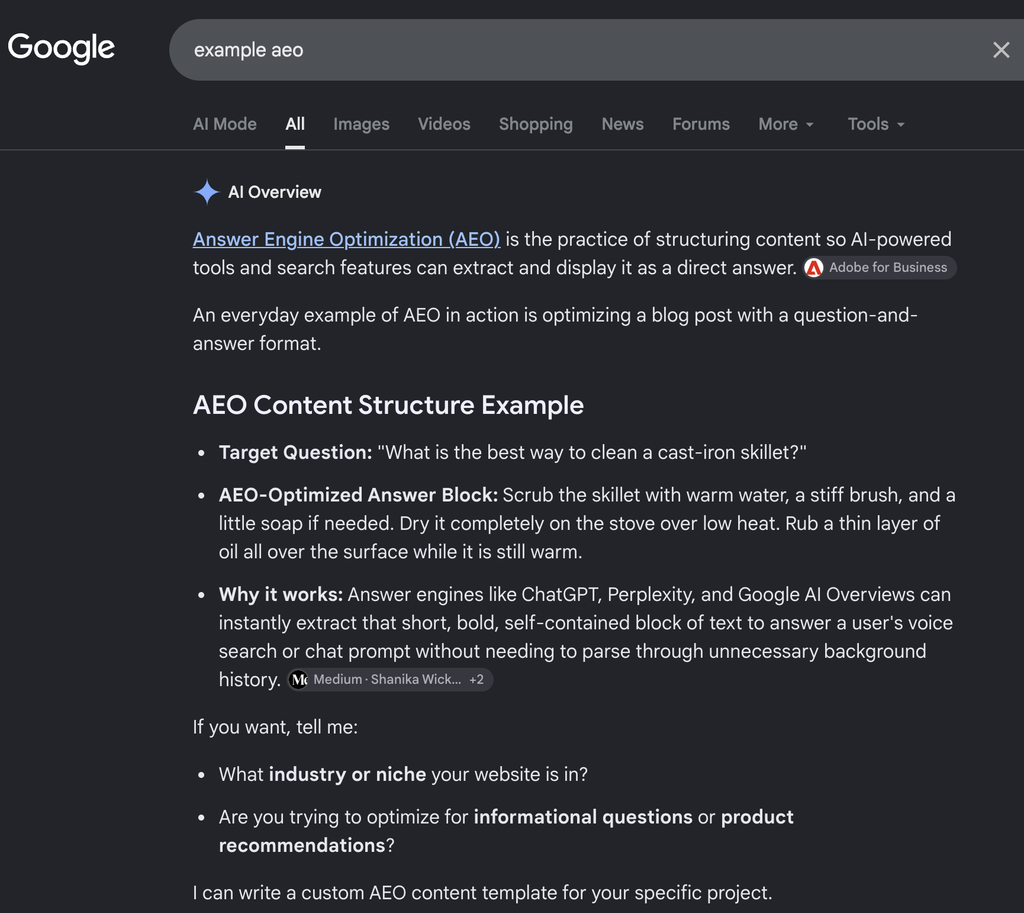
AEO stands for Answer Engine Optimisation. It is the practice of optimising your content so that it appears as a direct answer in search results rather than just a link that users click through to.
You have already seen AEO in action every time Google displays a Featured Snippet at the top of the results page a highlighted box that directly answers a question. AEO is the strategy behind getting your content into that position.
As users increasingly ask questions in conversational language especially on voice search and mobile — Google has evolved to answer those questions directly. Instead of returning ten blue links, it often returns one clear answer. AEO is about making sure that answer comes from your website.
What AEO Involves
- Structuring content to answer specific questions directly — using clear, concise language that Google can extract and display
- Using FAQ sections — question-and-answer format signals to Google that your content is answering real user queries
- Implementing FAQ and How-To schema markup — structured data that helps Google understand and display your content in rich results
- Targeting PAA (People Also Ask) boxes — identifying related questions your audience asks and answering them on the same page
- Writing in an inverted pyramid style — putting the direct answer first, then expanding with supporting detail
Why AEO Matters for Malaysian Businesses
In Malaysia, voice search usage is growing rapidly — particularly among younger consumers searching on smartphones in Malay and English. When someone asks their phone “what is the best homestay near KLCC,” they expect an immediate spoken answer, not a list of links to click through.
If your website is not optimised to provide that direct answer, you are invisible in that moment — even if you rank well in standard results.
Additionally, AEO is closely connected to GEO. The same content structure that earns featured snippets also makes your content more likely to be cited by AI platforms. This leads us to the third discipline.

What Is GEO (Generative Engine Optimisation)?
GEO stands for Generative Engine Optimisation. It is the newest of the three disciplines and arguably the most important for forward-looking businesses in Malaysia.
GEO is the practice of optimising your website and content so that it gets cited, referenced, and recommended by AI-powered search platforms. These include Google AI Mode, ChatGPT, Perplexity, Gemini, and other large language model (LLM) based search tools.
Here is the key difference: traditional SEO gets you ranked in a list of links. GEO gets you mentioned in an AI-generated answer.
When someone asks ChatGPT “which SEO agency in Malaysia is good for small businesses,” the AI does not show a ranked list of websites. Instead, it synthesises an answer from multiple sources and names specific companies it has identified as credible authorities on the topic. GEO is the work that gets your business into those answers.
You can learn more about how this works in our detailed guide on how to rank in AI search.
What GEO Involves
Entity building — making sure Google and AI platforms clearly understand who your business is, what services you offer, where you operate, and who you serve. This is achieved through consistent business information across all platforms, structured data, and brand mentions.
Original, citable content — AI platforms cite content that is factual, specific, and written from genuine expertise. Thin or templated content is rarely picked up. In-depth guides, original case studies, and expert commentary are far more likely to be referenced.
Schema markup — structured data like Organization, LocalBusiness, FAQPage, and Article schema helps AI systems read and categorise your content accurately.
Topical authority — AI systems favour websites that cover a topic comprehensively. A business that has published twenty well-structured articles on SEO is far more likely to be cited as an SEO authority than one with a single service page.
Consistent E-E-A-T signals — Experience, Expertise, Authoritativeness, and Trustworthiness. These signals matter enormously for AI citation. Author bios, case studies, client testimonials, and verifiable credentials all contribute.
Why GEO Is Urgent for Malaysian Businesses Right Now
At Google I/O 2026, Google confirmed that AI Mode has surpassed one billion monthly users — with queries more than doubling every quarter since launch. Platforms like ChatGPT and Perplexity are also seeing explosive growth in Malaysia.
The businesses that begin optimising for GEO today have a first-mover advantage. Most competitors in Malaysia have not started. The window to establish your brand as an AI-cited authority is open right now but it will not stay open indefinitely.
How SEO, AEO, and GEO Work Together
It is important to understand that SEO, AEO, and GEO are not three separate strategies competing for your budget. They are three layers of the same visibility strategy and they reinforce each other.
Think of it this way:
- SEO ensures Google can find, crawl, and rank your website
- AEO ensures your content is structured to provide direct answers — earning featured snippets and voice search visibility
- GEO ensures your expertise and content is recognised by AI platforms — getting your business cited in AI-generated responses
A website that is technically sound (SEO), answers questions directly and clearly (AEO), and demonstrates genuine authority through original content (GEO) is positioned to capture visibility across every surface where potential customers are searching — traditional results, voice search, featured snippets, and AI chat platforms.
Conversely, a business that only focuses on traditional SEO is optimising for one channel while leaving two others completely uncovered. As AI search continues to grow in Malaysia, this gap will become increasingly costly.
Real-World Example: How All Three Apply to a Malaysian Business
Let us say you run an interior design company in Kuala Lumpur. Here is how SEO, AEO, and GEO each play a role:
SEO — Your service pages rank on Google for keywords like “interior design company KL” and “renovation contractor Selangor.” Your website loads fast, has clean URLs, and internal links connect your key pages properly.
AEO — Your blog has a detailed FAQ answering “how much does a home renovation cost in Malaysia?” Google pulls your answer into a featured snippet. When someone asks this question by voice, your answer is read out.
GEO — You have published ten detailed articles on renovation topics, covering costs, timelines, design styles, and common mistakes. Your founder has an author bio with credentials and project photos. When someone asks ChatGPT “which interior design company in KL is good for a modern minimalist look,” your business is mentioned in the response because your content demonstrates clear expertise on that exact topic.
All three working together create a compounding visibility advantage that no single-channel approach can match.

How to Get Started With SEO, AEO, and GEO
The good news is that you do not have to build all three overnight. The most effective approach is to start with a strong foundation and build systematically.
Step 1 — Conduct an SEO audit. Before anything else, understand the current state of your website. Identify technical issues, content gaps, and structural problems that are holding back your rankings. You can start with our free SEO audit to get a clear picture of where your website stands.
Step 2 — Fix your technical foundation. Address crawling issues, page speed, mobile performance, and schema markup. Without this, AEO and GEO efforts are significantly less effective.
Step 3 — Restructure your content for direct answers. Review your existing pages and blog posts. Add FAQ sections, use clear H2 and H3 headings for each question, and ensure your content answers specific queries in the first one or two sentences.
Step 4 — Build topical authority. Publish a cluster of related content that covers your area of expertise comprehensively. This is the single most important GEO investment you can make.
Step 5 — Add schema markup. Implement at minimum: Organization, LocalBusiness, FAQPage, and Article schema across relevant pages.
Step 6 — Strengthen your E-E-A-T signals. Add author bios, real case studies, client testimonials, and credentials to your website. Make it undeniable that your business has genuine expertise in what it does.
If you want to build this knowledge yourself, we offer a free resource at Learn SEO covering the fundamentals of SEO strategy for Malaysian business owners and marketers.
Frequently Asked Questions
What is the difference between SEO and AEO?
SEO focuses on ranking your website in the traditional list of Google results. AEO focuses on getting your content featured as a direct answer in featured snippets, voice search results, and People Also Ask boxes. Both are important, and AEO-optimised content tends to perform better in traditional SEO rankings as well.
Is GEO the same as AI SEO?
They refer to the same concept. GEO — Generative Engine Optimisation — is the formal term for optimising content to appear in AI-generated answers on platforms like ChatGPT, Google AI Mode, Gemini, and Perplexity. Some practitioners also call this AI SEO or LLM optimisation.
Do small businesses in Malaysia need GEO?
Yes — especially local service businesses. When potential customers ask AI platforms for recommendations on services in a specific area, the businesses that have established clear authority through content and entity signals are the ones that get recommended. Starting GEO early gives smaller businesses a real advantage before larger competitors catch up.
How long does it take to see results from AEO and GEO?
AEO results — like featured snippets — can sometimes appear within weeks of publishing well-structured content. GEO results take longer because they depend on building topical authority and entity recognition over time. Most businesses start seeing meaningful AI visibility improvements within 3 to 6 months of consistent effort.
Can I do SEO, AEO, and GEO myself?
The foundational elements of all three can be learned and implemented without an agency. However, technical SEO, schema markup, and strategic content planning are significantly more effective when guided by expertise. Our free SEO learning resource is a good starting point if you want to build your own knowledge first.
What should I prioritise first — SEO, AEO, or GEO?
Always start with SEO. A solid technical and on-page foundation makes AEO and GEO efforts far more effective. Once your website is technically healthy and your core pages are properly optimised, layer in AEO content structure and then build toward GEO through topical authority and entity signals.
Thoughts
SEO, AEO, and GEO are not three separate trends to choose between. They are three layers of a modern search visibility strategy — and in 2025, businesses in Malaysia that understand and implement all three will have a clear advantage over those that do not.
The search landscape is evolving fast. Google AI Mode has already passed one billion users. ChatGPT and Perplexity are growing rapidly in Malaysia. The question is not whether AI search will change how your customers find you — it already has. The question is whether your business will be visible in that new environment or not.
Start with a proper audit, build your foundation, and grow your visibility across every surface where your customers are searching.
Written by the Creative Site team — an SEO agency in Malaysia specialising in Search & AI Visibility. Explore our AI search ranking guide or start learning SEO for free.